
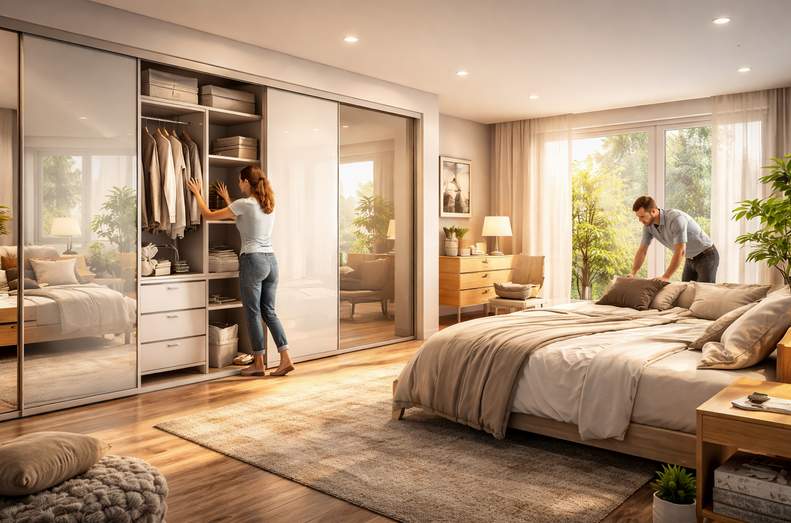
When Doors Stop Demanding Attention
Traditional hinged doors require clearance. That clearance is rarely optional, and it quietly dictates where everything else must go. Beds inch away from walls, nightstands shrink in size, and chairs get relocated to corners where they serve mostly as clothing storage. The result is a layout shaped less by intention and more by accommodation.Sliding wardrobes remove that constraint entirely. With no arc of movement to account for, the space in front of the wardrobe becomes usable again. You can walk closer, place furniture nearby, and move freely without performing a small choreography every time you need a sweater. The room stops revolving around a door and starts responding to how people actually live.
Movement Patterns You Don’t Notice Until They Improve
Designers often think in terms of flow—how a person naturally moves through a space without friction. Swing doors disrupt that flow by creating temporary barriers. Open one at the wrong moment, and suddenly the room has a new wall.Sliding systems keep pathways consistent. Nothing swings out to surprise you. The route from bed to wardrobe to window remains uninterrupted, which makes the space feel calmer and more predictable. It’s the difference between walking through a room and negotiating with it.
There’s also a psychological effect. Fewer interruptions create a sense of ease, even if the square footage hasn’t changed. The room feels larger, not because it is, but because it behaves like it is.
Furniture Finally Gets a Say
Once the tyranny of door clearance disappears, furniture placement becomes far more flexible. Beds can sit closer to wardrobes without turning daily routines into obstacle courses. Desks can occupy previously unusable zones. Even something as simple as a larger bedside table suddenly becomes possible.Designers take advantage of this freedom in several ways:
- Positioning beds centrally instead of awkwardly offset
- Adding functional seating where doors once needed space
- Creating balanced layouts rather than compromised ones
Making Awkward Corners Earn Their Keep
Not every room arrives with perfect proportions and generous spacing. Some come with angled walls, narrow widths, or that one corner that seems determined to remain useless. Traditional wardrobes often amplify these challenges because their doors need room to open outward, turning already tricky areas into zones of avoidance.Sliding wardrobes allow designers to reclaim these spaces. Because the doors move laterally, they can be installed along walls that would otherwise feel too tight or irregular. That narrow stretch beside the bed or the shallow recess near the window suddenly becomes viable storage instead of a design headache.
In compact bedrooms, this can mean the difference between fitting a full wardrobe and settling for something undersized. In more complex layouts, it allows storage to follow the architecture rather than fight against it. The result is a room that feels resolved instead of reluctantly arranged.
Visual Calm Without the Extra Effort
Sliding wardrobes also contribute to how a room looks, not just how it functions. Their flat, continuous surfaces create a cleaner visual line, which reduces the sense of clutter. There are no protruding handles or open doors interrupting the view.This simplicity has a quiet effect. The eye moves across the room without stopping at unnecessary details. When mirrored panels are used, the space can feel even more open, reflecting light and extending sightlines. It’s a practical illusion, but a welcome one.
There’s also something reassuring about a door that doesn’t suddenly appear in your peripheral vision. No surprises, no sudden obstacles—just a steady, consistent presence that behaves exactly as expected.
Small Changes That Add Up Quickly
What makes sliding wardrobes particularly effective is that their benefits are cumulative. Each small improvement—better flow, smarter furniture placement, reclaimed corners—adds up to a noticeable transformation in how the room feels and functions.- More usable floor space without increasing room size
- Fewer interruptions in daily movement
- Greater flexibility in layout decisions
- A cleaner, more cohesive visual environment
Sliding Into Better Living
Rooms don’t need dramatic renovations to feel different. Sometimes, removing a single constraint—like the swing of a wardrobe door—is enough to unlock a cascade of improvements. Sliding wardrobes achieve this without fanfare. They don’t announce their presence or ask for recognition.What they offer instead is subtle efficiency. Movement becomes smoother, layouts become more logical, and spaces that once felt cramped begin to breathe a little easier. The room stops asking for compromises and starts offering options.
And while no piece of furniture can solve every design challenge, it’s hard to ignore one that manages to stay out of your way so effectively. In a world where so many things demand attention, that alone feels like a small luxury.
Article kindly provided by bedroomsplusonline.co.uk