
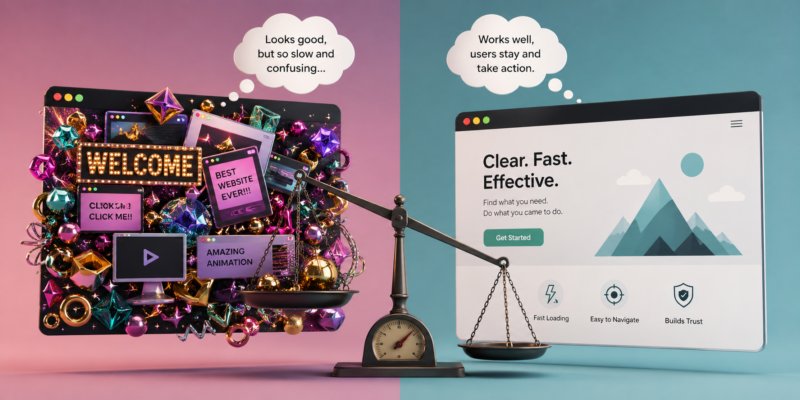
Design is often treated as a finishing layer, something to polish once the “real” work is done. That mindset tends to reward what looks impressive in screenshots rather than what works under real conditions. Subtle delays, confusing layouts, and visual clutter don’t announce themselves loudly. They just chip away at attention until users decide their time is better spent elsewhere.
When Beauty Slows Everything Down
A page packed with high-resolution images, layered animations, and decorative flourishes might feel luxurious during the design phase. In reality, it often behaves like a suitcase that’s been packed with everything “just in case.” It looks prepared, but it’s heavy, awkward, and a bit exhausting to carry.Performance is not an abstract metric—it’s a user experience. Every extra second of load time increases the likelihood that someone leaves before seeing anything meaningful. Mobile users, especially, have little patience for a site that hesitates before showing its content. A slick animation that takes two seconds to load rarely impresses anyone. It mostly just delays the reason they came.
There’s also a compounding effect. A few large images here, a fancy font there, and suddenly the page feels like it’s wading through syrup. No single element seems responsible, which makes it harder to fix.
Clarity Gets Lost in the Decorations
Visual design should guide attention, not compete for it. When every section tries to stand out, nothing actually does. Bright colors, overlapping elements, and bold typography can create a kind of visual noise that makes it difficult to understand what matters.Users don’t analyze a page—they scan it. They’re looking for cues that confirm they’re in the right place and help them move forward. If those cues are buried under stylistic choices, the experience becomes frustrating. It’s similar to walking into a room where every surface is covered in patterns. Impressive at first glance, but disorienting after a few seconds.
Serious decisions, like making a purchase or submitting an inquiry, depend on clarity. If a user has to think too hard about what to do next, they often choose the simplest option available: leaving.
Small Checks That Make a Big Difference
Improving the balance between aesthetics and performance doesn’t require abandoning visual appeal. It requires discipline. A few practical checks can reveal where design is helping and where it’s quietly causing problems.- Test load speed on mobile connections, not just high-speed desktops
- Remove or compress large images that don’t serve a clear purpose
- Limit the number of fonts and animation effects on a single page
- Ensure key actions are immediately visible without scrolling or guessing
A well-designed site doesn’t draw attention to every detail. It creates a smooth path where users instinctively know where to look and what to do. When that happens, design stops being something people notice and starts being something they appreciate without thinking about it.
Designing for Intent, Not Applause
There’s a subtle trap in designing for reactions instead of results. A layout that earns compliments in a review meeting can still fail quietly in the real world. Users are not handing out design awards; they’re trying to solve a problem quickly. If a page slows them down, even slightly, the impression fades faster than any gradient effect.Intent-driven design starts by asking a simple question: what should someone do here, and how quickly can they do it? Everything else becomes secondary. This doesn’t eliminate creativity—it gives it direction. A striking visual element can still exist, but it needs to earn its place by supporting the user’s journey rather than interrupting it.
Serious projects benefit from restraint. Not minimalism for its own sake, but purposeful selection. Each component should justify its presence. If it doesn’t guide, inform, or reassure, it’s probably decoration—and decoration has a habit of overstaying its welcome.
Trust Is Built Faster on Stable Ground
Users form opinions quickly, often before reading a single sentence. A fast-loading, well-structured page signals competence. A slow or confusing one raises quiet doubts. Even if the content is excellent, the delivery shapes how that content is perceived.Trust isn’t just about testimonials or polished visuals. It’s about consistency. Buttons behaving as expected, pages loading without hesitation, and information appearing where it should. These details rarely get applause, but their absence is noticeable in an instant.
There’s also a psychological comfort in simplicity. When a site behaves predictably, users feel more in control. That sense of control makes them more likely to engage, explore, and take action. It’s not flashy, but it’s effective.
Style Points vs Speed Points
At some stage, every design faces a quiet trade-off. Add another visual flourish or keep things lean. It’s tempting to believe there’s always room for one more enhancement. After all, what’s one extra animation?Multiply that thinking across an entire page, and the answer becomes clear. What started as a small embellishment turns into a layered experience that demands more from both the browser and the user. Meanwhile, the core message waits patiently, hoping to be noticed.
A useful exercise is to remove elements one by one and observe what actually changes. If the page still communicates effectively without something, that element was likely optional. If removing it improves speed and clarity, it was more than optional—it was a liability.
Less Glitter More Getting Things Done
A strong design doesn’t compete with itself. It prioritizes, simplifies, and delivers. Visual appeal still matters—it just works quietly in the background, supporting the experience rather than dominating it.There’s a certain satisfaction in a site that feels effortless to use. Pages load quickly, information is easy to find, and actions feel natural. No one leaves thinking about how efficient it was, but they remember that it worked. And in practice, that memory is far more valuable than any fleeting moment of visual admiration.
Design that balances beauty and performance doesn’t feel restrained. It feels intentional. And intention, more than decoration, is what keeps people engaged long enough to actually do something.
Article kindly provided by framelywebdesigns.com