
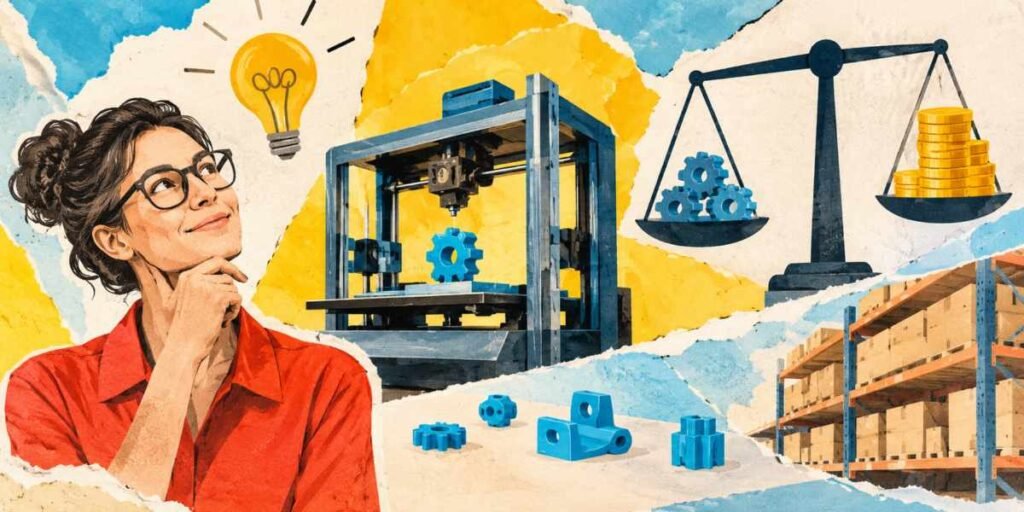
Small-batch manufacturing challenges that approach. Rather than producing thousands of identical components, businesses can manufacture ten, twenty or fifty units, testing demand and refining designs before committing substantial resources. Thanks to technologies such as 3D printing, CNC machining and digital manufacturing, producing limited quantities is increasingly practical.
Why Cheaper Per Unit Doesn’t Always Mean Cheaper Overall
Traditional mass production benefits from economies of scale. Once expensive tooling has been created, producing additional components becomes relatively inexpensive. Injection moulding, for example, can manufacture thousands of plastic parts at remarkably low unit costs.However, creating the mould itself might cost several thousand pounds. For a business requiring only ten specialised components, that initial investment can make the entire project commercially ridiculous.
Consider a hypothetical component that costs £4,000 to tool and £2 per unit to manufacture. Producing 1,000 units would cost £6,000, or £6 per component. Alternatively, a specialist manufacturer might produce ten equivalent components using 3D printing at £45 each.
The second approach has a substantially higher unit price, but the total expenditure is just £450 rather than £6,000. Unless the business genuinely needs hundreds of components, the supposedly expensive option becomes considerably more economical.
The important calculation isn’t simply cost per unit. It’s the total cost of obtaining the quantity actually required.
Inventory Is Money Wearing a Dusty Coat
Every unsold component represents money that cannot be used elsewhere. Businesses must also consider storage costs, insurance, handling, deterioration and the possibility that products become obsolete before reaching customers.For small companies, these risks can be particularly significant. Ordering 2,000 specialised fittings might secure an attractive discount, but that discount becomes meaningless if only 150 are sold.
Small production runs allow businesses to match manufacturing quantities more closely to actual demand. Instead of predicting sales eighteen months into the future, they can manufacture smaller quantities and reorder when necessary.
This approach also reduces the consequences of unexpected market changes. A component designed for a particular machine might become obsolete following a manufacturer’s redesign. Producing ten replacements when customers need them is considerably safer than maintaining a stockpile of several hundred.
Testing Ideas Without Betting the Workshop
Inventors frequently discover that their first design works beautifully until someone actually uses it. A mounting bracket might be slightly too narrow, a casing might overheat, or a carefully positioned button might prove accessible only to people with unusually talented thumbs.Small production runs make these discoveries less financially painful.
Manufacturing ten functional prototypes allows businesses to evaluate durability, usability, assembly requirements and customer reactions under realistic conditions. Feedback can then inform improvements before larger quantities are produced.
This process is particularly valuable for specialised equipment, medical-device development, industrial accessories and niche consumer products, although regulated applications may require extensive validation regardless of production quantity.
A limited manufacturing run is therefore more than a purchasing decision. It can become an essential stage of product development, transforming expensive assumptions into measurable evidence.
Design Changes Without Financial Heartbreak
One of the greatest advantages of small-batch manufacturing is the freedom to make changes without abandoning expensive equipment or enormous quantities of existing stock.Traditional manufacturing often requires considerable investment in tooling, particularly when producing injection-moulded components. Once a mould has been manufactured, changing the dimensions or geometry of a product can involve additional machining, replacement tooling or substantial delays.
Digital manufacturing offers considerably more flexibility. With 3D printing, for example, modifying a component might involve adjusting a CAD file and producing another batch. A revised mounting hole, thicker supporting wall or improved ventilation opening can potentially be incorporated without purchasing new tooling.
This flexibility is particularly useful when developing products that must fit existing machinery or accommodate customer-specific requirements.
However, design freedom still requires discipline. Every modification should be documented, tested and evaluated. Changing a component simply because the software makes it easy is not necessarily an improvement. Sometimes the original design was perfectly adequate, even if its inventor has developed an emotional attachment to version seventeen.
Manufacturing When Customers Actually Order
On-demand production takes small-batch manufacturing a stage further by reducing the need to maintain physical inventory.Instead of storing finished components, businesses can maintain digital design files and manufacture products when orders arrive. This approach can be particularly attractive for replacement parts, specialist accessories and components serving relatively small markets.
Imagine a company supplying replacement plastic covers for discontinued industrial equipment. Demand might amount to only twenty units annually, with orders arriving unpredictably.
Traditional manufacturing could require purchasing hundreds of covers upfront. On-demand production allows the company to manufacture individual replacements or small batches as customers request them.
There are limitations. Production capacity, material availability, quality control and delivery times must all be considered. Customers requiring immediate replacement parts may not appreciate discovering that their urgently needed component is still a collection of instructions on somebody’s computer.
Nevertheless, for products with irregular demand, digital inventory can be considerably more practical than shelves filled with physical stock.
When Bigger Really Is Better
Small production runs are not automatically the most economical solution.When demand is predictable and quantities are substantial, traditional mass manufacturing generally offers significant advantages. Injection moulding, automated assembly and other established production methods can deliver excellent consistency, rapid output and exceptionally low unit costs.
Manufacturing methods also affect component properties. A 3D-printed replacement may differ from an injection-moulded original in strength, surface finish, dimensional accuracy or resistance to environmental conditions.
Businesses must therefore evaluate the intended application rather than assuming that every manufacturing technique produces interchangeable results.
A useful starting point is calculating the break-even quantity at which tooling investment becomes worthwhile. This involves comparing setup costs, unit prices, finishing expenses, inspection requirements and anticipated demand.
Small Runs Can Make a Big Impression
Manufacturing success should not be measured exclusively by the number of components leaving a factory.For inventors and smaller businesses, producing precisely what customers need can be more profitable than achieving impressive production volumes. Limited runs reduce financial exposure, encourage experimentation and allow companies to respond more quickly to changing requirements.
The smartest manufacturing strategy might involve producing ten components initially, refining the design, manufacturing another fifty and eventually moving to mass production once demand justifies the investment.
Equally, a specialised product might never require more than ten units at a time. That doesn’t make it commercially unsuccessful.
After all, producing ten components that customers genuinely need is considerably more rewarding than manufacturing ten thousand that eventually become very expensive landfill.
Article kindly provided by i-am3d.com