
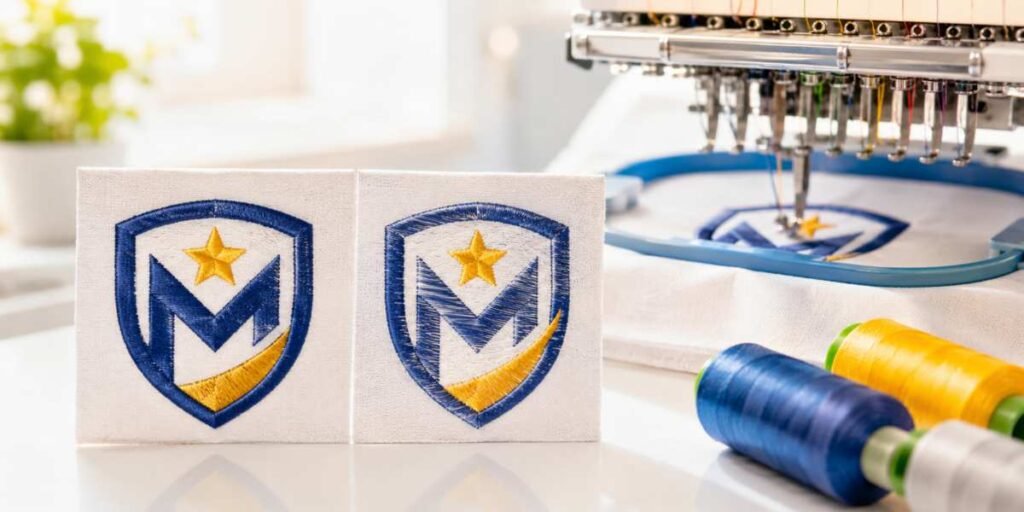
Many people assume embroidery simply involves loading an image into software, pressing a button and watching thread perform its magic. If only it were that easy. Every experienced embroiderer knows that a machine faithfully follows instructions, whether those instructions are brilliant or questionable. Machines never wake up feeling creative, nor do they decide that today would be an excellent opportunity to improve someone’s logo.
Stitch Direction Shapes What the Eye Sees
Stitch direction is one of the least obvious yet most influential parts of embroidery design. It determines the angle at which every group of stitches is placed across the fabric. Although two sections may use identical thread colours, changing the stitch angle can dramatically alter how light reflects from the surface.This is why a simple embroidered leaf may appear to have natural veins, or why one half of a letter seems brighter than the other despite using exactly the same thread. The effect is created by light reflecting differently from stitches travelling in separate directions.
Professional digitisers deliberately vary stitch angles to separate neighbouring objects, improve readability and create visual depth. Without those adjustments, adjoining sections can blend together into an indistinct block of thread that looks far less impressive than the original artwork suggested.
Sequence Matters More Than Most People Imagine
Embroidery follows a carefully planned sequence rather than randomly filling areas until everything looks complete. Every section influences the next.Large background areas are often stitched before smaller details. Borders may be added after fills. Fine lettering frequently comes near the end, reducing the chance of distortion caused by surrounding stitches pulling the fabric in different directions.
An incorrect sequence can create subtle problems that become impossible to ignore once the embroidery finishes. Registration may drift slightly, outlines may no longer meet perfectly and tiny details can appear to wander off as though they decided to explore the garment independently.
Planning the correct order also reduces unnecessary machine movement. Less jumping between distant areas means fewer trims, cleaner thread paths and a smoother finished appearance.
Density Is a Balancing Act
One of the biggest misconceptions about embroidery is that adding more stitches automatically improves quality. Quite the opposite can happen.Excessive stitch density packs too much thread into a confined area. Instead of producing a richer design, it may create stiffness, puckering and raised sections that resemble miniature speed bumps. Needles work harder, thread experiences greater friction and even durable fabrics can begin to protest.
Insufficient density presents the opposite challenge. Fabric may become visible through the stitches, colours appear weaker and the design loses its solid appearance.
Finding the correct balance requires experience, testing and an understanding of how different thread types interact with different materials. What works beautifully on one garment may produce disappointing results on another.
Fabric Is Never Just a Background
Fabric plays an active role in every embroidered design. It stretches, compresses, shifts and responds differently depending on its construction.A stable cotton shirt behaves very differently from a fleece jacket, while a towel introduces another challenge entirely because stitches must compete with thick loops that seem determined to hide every carefully embroidered detail. Even tiny lettering can disappear into the surface unless the design has been prepared specifically for that material.
Professional embroidery accounts for these differences before digitising begins. Stabilisers, underlay stitches and compensation settings all work together to ensure the finished design remains accurate despite the fabric’s natural behaviour.
Underlay Does the Hard Work Nobody Notices
Hidden beneath the visible stitching is a foundation that rarely receives any attention outside the embroidery industry. Underlay stitches are placed before the decorative thread and serve as the structural support for everything that follows. They help secure the fabric, reduce movement and provide a smoother surface for the upper stitches.Different designs call for different underlay techniques. A broad satin border may benefit from one approach, while detailed lettering or filled shapes may require another. Selecting the wrong underlay can leave even perfectly planned top stitching struggling to achieve its intended appearance. Much like a building, the attractive part only performs well when the unseen structure beneath it has been carefully planned.
Tiny Details Demand Careful Compromise
Not every element found in digital artwork can be reproduced faithfully with thread. Hairline borders, microscopic text and intricate shading may look wonderful on a computer monitor but become far less cooperative once translated into embroidery.Professional digitising often involves making subtle adjustments that preserve the overall appearance while respecting the physical limitations of thread and fabric. Lines may be thickened slightly, lettering enlarged, or decorative details simplified so they remain sharp after thousands of stitches have been sewn.
These changes are rarely noticeable to the casual observer. In fact, people often assume the embroidered version is identical to the original artwork because the important visual characteristics have been preserved. The goal is not to copy every pixel but to recreate the design successfully using thread as the medium.
Experience Makes Technical Decisions Look Effortless
Embroidery digitising blends technical knowledge with practical judgement. Software provides powerful tools, but it cannot automatically understand how a particular cap differs from a polo shirt or how one fabric will react compared with another. Those decisions still rely on experience built through testing, observation and continual refinement.Professional-quality embroidery usually reflects dozens of small choices rather than one dramatic improvement. Stitch direction, density, sequencing, compensation, underlay and fabric characteristics all influence one another. Altering a single setting may improve one section while creating unexpected issues elsewhere, making careful planning essential.
That is why two files created from the same logo can produce remarkably different results. One has simply been instructed with greater precision, anticipating how thread, fabric and machine will interact long before production begins.
Keeping Everything in Line
Embroidery is far more than converting artwork into stitches. Every finished logo represents a collection of engineering decisions disguised as decoration. When stitch angles complement one another, densities remain balanced, sequencing is carefully planned and the fabric has been properly considered, the finished result looks clean, durable and professional without drawing attention to the complex work behind it.Perhaps that is the greatest compliment an embroidered design can receive. Nobody looks at it and wonders how many technical decisions made it possible. They simply notice a logo that looks exactly as it should, sitting confidently on the garment as though it had always belonged there. Behind that effortless appearance lies plenty of careful planning, quiet expertise and enough invisible preparation to keep even the busiest embroidery machine happily on the straight and narrow.
Article kindly provided by impactdigitizing.com