
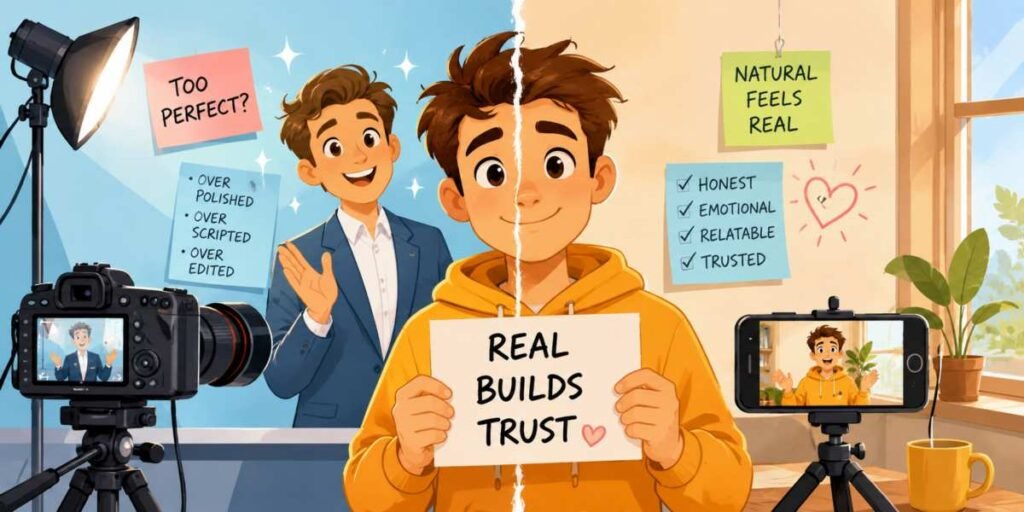
Viewers are sharper than many brands, creators, and event organisers give them credit for. They may not know the difference between a prime lens and a zoom lens, but they can usually sense when a video feels too polished, too rehearsed, or too carefully scrubbed of real life. When every frame looks like it has been approved by a committee wearing matching lanyards, the result can feel less like communication and more like a hostage statement with nicer lighting.
Imperfect video works because it carries evidence of reality. A natural pause in an interview, a quick glance off-camera, a laugh that slightly disrupts the sentence, or a speaker correcting themselves can make the person on screen feel more trustworthy. These small moments remind viewers that they are watching a human being, not a waxwork with a content strategy.
Polish Can Start to Feel Suspicious
Highly produced video is not automatically a problem. Beautiful lighting, clean sound, careful editing, and strong framing all matter. A wedding film, brand story, documentary, or social media campaign should not look like it was filmed by someone sprinting through a cupboard. Quality helps people stay engaged.The issue begins when polish removes all signs of spontaneity. When footage is too perfect, viewers may wonder what has been hidden, trimmed, softened, or staged. A corporate interview where every answer sounds pre-approved can feel distant. An event film that only shows perfect smiles may miss the actual atmosphere. A documentary that refuses to leave in any awkwardness can accidentally drain the truth from the subject.
Trust often lives in the details that polished video is tempted to remove. The speaker who briefly searches for the right words may seem more honest than the one who delivers every line like a luxury lift announcement. The behind-the-scenes clip with slightly messy framing can feel more believable than the glossy campaign video where nobody appears to have pores, doubts, or normal shoes.
Why Authentic Moments Matter at Events
Event videography provides some of the clearest examples of this principle. People rarely remember a conference because the stage lighting was perfectly balanced. They remember the unexpected reactions, the conversations during breaks, the nervous excitement before a presentation, or the spontaneous applause when something genuinely resonates.A video that captures those unscripted moments often feels more engaging than one built entirely from staged interactions. Genuine expressions create emotional context. They show what people actually experienced rather than what organisers hoped they experienced.
This does not mean every shaky shot deserves a place in the final edit. It means that authenticity should not be sacrificed in pursuit of technical perfection. A brief imperfect moment that captures real emotion can carry far more weight than a flawless shot containing no emotional connection whatsoever.
Interviews Reveal the Human Behind the Message
Interviews are another area where authenticity plays a powerful role. When viewers watch someone speak naturally, they are evaluating more than the words being said. They are also judging sincerity, confidence, and credibility.A carefully edited interview can sometimes become too clean. Every pause disappears. Every hesitation vanishes. Every sentence flows together with robotic efficiency. While the result may sound impressive, it can also feel strangely artificial.
Many successful documentary filmmakers intentionally leave small imperfections intact. A subject might pause to think. They may briefly lose their train of thought. They might laugh at their own comment. These moments help establish trust because they demonstrate that the conversation is genuine rather than manufactured.
Some of the most memorable documentary interviews contain moments that an overenthusiastic editor would probably remove within seconds. Fortunately, restraint can be every bit as valuable as technical skill.
Social Media Changed Audience Expectations
Social platforms have accelerated this shift toward authenticity. Audiences now consume enormous amounts of content that feels immediate and unfiltered. They regularly watch creators filming in kitchens, cars, spare bedrooms, and occasionally locations that appear to be experiencing a mild storage crisis.Because viewers have become accustomed to this style, highly polished content can sometimes feel less relatable. A creator speaking directly to a phone camera may generate more trust than a heavily produced video featuring dramatic music, cinematic drone shots, and enough lens flares to signal aircraft.
The success of many social media personalities is not built on technical perfection. It is built on consistency, personality, and authenticity. Viewers feel as though they are seeing the real person rather than a carefully constructed version designed to appeal to everyone and connect with nobody.
Finding the Sweet Spot
The goal is not to create poor-quality video. Nobody is arguing that bad audio, chaotic camera work, or accidental shots of the floor should become industry standards.The most effective videos usually balance professionalism with authenticity.
- Prioritise clear audio and strong storytelling.
- Keep genuine reactions whenever they add value.
- Avoid over-editing interviews into perfection.
- Include natural moments alongside polished visuals.
- Focus on emotional truth rather than technical obsession.
A Few Frames Out of Place
The irony of modern video production is that the tools designed to eliminate every imperfection can sometimes eliminate trust as well. Audiences connect with people, not perfection. They respond to sincerity, not spotless execution.Great videography still requires skill, planning, and attention to detail. Yet the strongest videos often leave room for life to appear on screen. A natural reaction, an unscripted moment, or a slight imperfection can remind viewers that there are real people behind the camera and in front of it.
When authenticity and quality work together, the result is something far more valuable than perfection. It is credibility, and that is far harder to fake than a smooth edit.
Article kindly provided by nulamedia.co.uk